
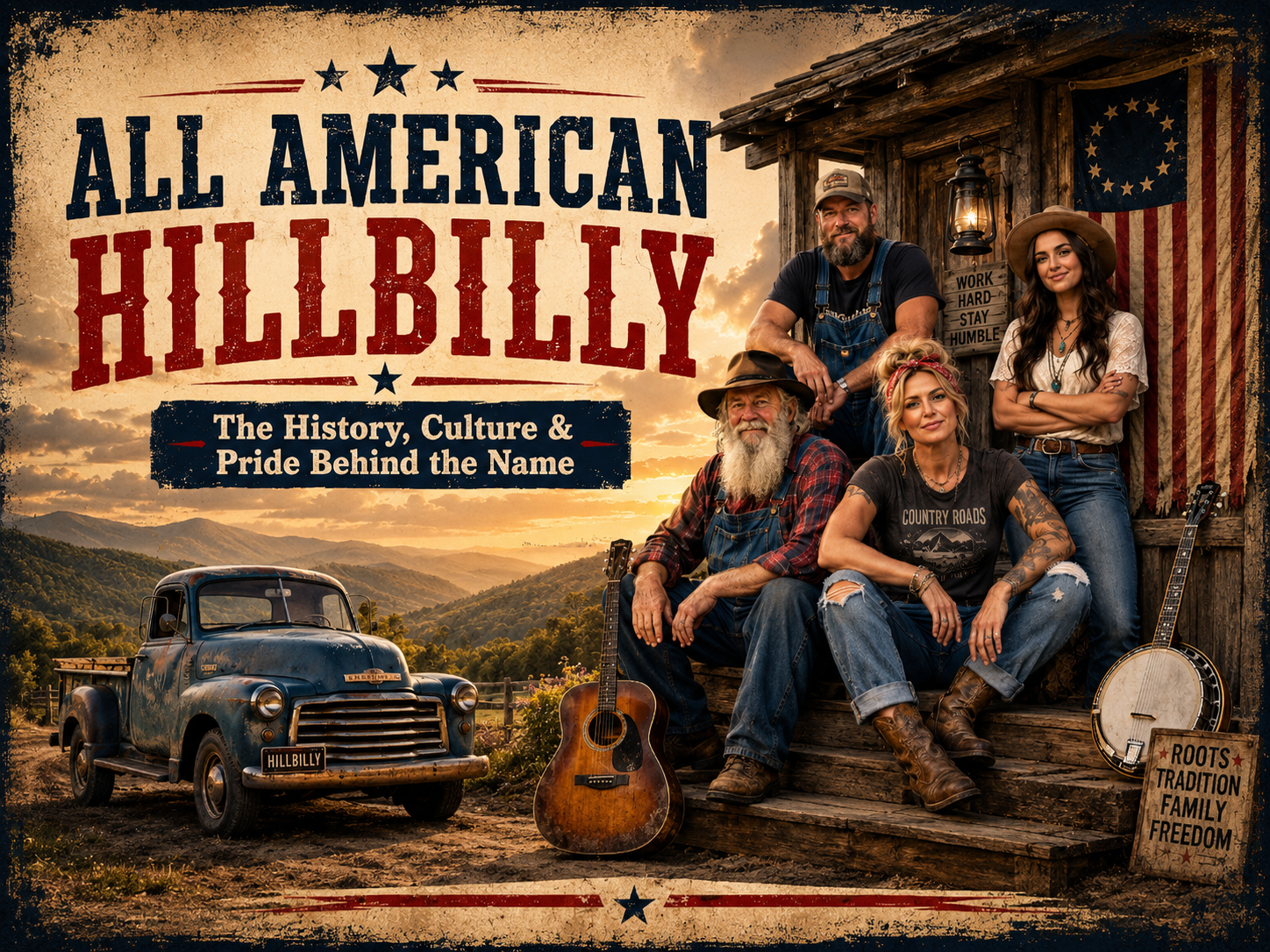
The History, Culture, and Pride Behind the All American Hillbilly
Some words carry a story bigger than a dictionary can hold, and “hillbilly” is one of them. For some people, it has been thrown around as an insult. For others, it is worn like a badge of honor, stitched right into the denim of family history, backroads living, mountain music, hard work, and a stubborn kind of independence that refuses to be polished up for anybody’s approval. Around here, “All American Hillbilly” is not about making fun of anyone. It is about pride, grit, humor, roots, and the kind of people who know how to make something out of nothing and still have enough left over to help a neighbor.
The word “hillbilly” is most often connected to rural mountain people, especially those from Appalachia and the Ozarks. Appalachia itself is not some tiny forgotten corner. It stretches across a wide part of the eastern United States, from southern New York all the way down toward northern Mississippi, with millions of people living across hundreds of counties. That right there should tell you something. There is no single kind of hillbilly. There are hillbillies who grew up poor, and hillbillies who did just fine. There are hillbillies with college degrees, family farms, mechanic shops, military service, small businesses, music careers, construction crews, law offices, classrooms, and kitchen tables full of grandbabies and biscuits. The culture is not one flat stereotype. It is a wide, living thing.
The name itself has a long and sometimes debated history. In simple terms, “hill” points to people from the hills and mountains, while “billy” has often been understood as an old word for a fellow, companion, or common man. Over time, especially in American newspapers, stories, music, and movies, the word became attached to rural mountain people. Sometimes it was used with warmth. Other times, outsiders used it to paint people as backward, wild, poor, or foolish. Like a lot of old labels, the meaning depends on the mouth it comes out of. Said with a sneer, it can sting. Said by somebody who lives it, loves it, and respects it, it can mean home.
Popular culture has not always been fair to hillbillies. Movies, cartoons, TV shows, and jokes have often shown them as uneducated rubes with missing teeth, bare feet, busted-down shacks, and not much sense. That image got repeated so many times that plenty of people started believing it was the whole truth. But anyone who has actually spent time around real mountain, country, and rural working people knows better. These are not cardboard characters. They are welders, nurses, farmers, veterans, truck drivers, artists, teachers, musicians, hunters, preachers, business owners, mothers, fathers, sons, daughters, and neighbors. Some are rough around the edges. Some are polished as a Sunday belt buckle. Most are a little bit of both.
Hillbilly culture is built on survival, but not the sad kind. It is the kind of survival that can fix a fence with what is lying in the barn, stretch supper for two extra visitors, keep old trucks running long past their expected expiration date, and turn a front porch into the best seat in the county. It is knowing the value of land, tools, family, freedom, and a good dog. It is also knowing how to laugh when life gets sideways, because sometimes humor is the only thing between you and throwing a wrench clean across the yard.
Music is a big part of the story too. Appalachian and rural Southern music came from many hands and many histories. Fiddle tunes, ballads, church songs, work songs, banjo picking, blues, gospel, bluegrass, and country music all crossed paths over time. The banjo, now often linked with mountain music, has deep African roots. Fiddle music carried Irish, Scottish, English, and other European influences. The sound that came out of those hills was not simple. It was a mix of hardship, joy, faith, dance, heartbreak, and plain old Saturday night noise. That music helped shape American culture far beyond the mountains.
Food, too, tells part of the tale. Beans, cornbread, greens, biscuits, fried potatoes, garden tomatoes, smoked meat, chow-chow, preserves, and cast-iron cooking are not just meals. They are memory. They are “come on in, there’s enough.” They are recipes passed down by people who may not have written much down but knew exactly how the dough should feel. Hillbilly culture has always had a practical side. Use what you have. Waste as little as possible. Feed whoever shows up hungry. That way of living may look old-fashioned to some, but it carries a lot more wisdom than people give it credit for.
There is also a strong streak of independence in the hillbilly name. Not the fake kind that just talks big, but the kind that comes from living where help may be a long drive away. Mountain and country people have often had to depend on their own hands, their families, and their communities. That does not mean they reject the modern world. It means they know there is still value in practical skills, common sense, privacy, faith, humor, loyalty, and standing your ground when something matters.
Of course, no culture is perfect, and hillbilly life should not be turned into some fake picture where everyone is noble, cheerful, and sitting on a porch at sunset with a spotless banjo. Real life is messier than that. Rural communities have had poverty, hard labor, family struggles, isolation, addiction, unfair treatment, and plenty of people looking down on them from the outside. But those struggles are not the whole story either. The full story includes pride, creativity, intelligence, toughness, music, craftsmanship, storytelling, service, faith, and a deep sense of place.
That is why “All American Hillbilly” means something worth celebrating. It takes a word that has been pushed around, laughed at, and misunderstood, and gives it back some backbone. It says that being country, rural, mountain-born, backwoods-raised, or hillbilly at heart is not something to hide from. It can mean you know where you come from. It can mean you respect hard work. It can mean you believe freedom is more than a slogan. It can mean your roots run deep, your humor runs wild, and your heart stays loyal to the people and places that made you.
So no, “hillbilly” does not have to be a dirty word. Around here, it is not about mocking anyone. It is about honoring the real people behind the name. The ones with grease on their hands, songs in their blood, stories on the porch, boots by the door, and a little rebel spark that refuses to go out. All American Hillbilly is not a costume. It is a culture, a wink, a raised glass, a muddy driveway, a family story, and a reminder that pride does not have to be fancy to be real.
Call it country. Call it mountain. Call it backroad. Call it hillbilly. Just make sure you say it with respect.
